
The Janet Hodgson levitation photos are one of the most controversial pieces of paranormal evidence ever recorded.
One of the most famous pieces of evidence connected to the Enfield Poltergeist is a series of photographs showing Janet Hodgson appearing to levitate above her bed.
Taken in 1977 during the investigation of the Hodgson family home in Enfield, North London, the images quickly became some of the most widely discussed paranormal photographs ever captured. The pictures appear to show the young girl suspended in mid-air while investigators and photographers documented the strange events occurring inside the house.
Supporters of the case argue that the photographs provide compelling visual evidence of paranormal activity. Skeptics, however, claim the images simply show Janet jumping from her bed at the moment the camera shutter was pressed.
More than four decades later, the photographs remain one of the most debated pieces of evidence from the Enfield haunting.
So what do the famous Janet Hodgson levitation photos actually show — and are they real evidence of the paranormal, or simply a clever illusion?
The Night the Levitation Photos Were Taken
The famous levitation photographs were taken in 1977 during the investigation of the Hodgson family home in Enfield, North London. At the time, paranormal researchers and journalists had gathered at the house after reports of unexplained disturbances, including furniture moving, knocking sounds, and objects being thrown across rooms.
During one evening of the investigation, photographer Graham Morris from the Daily Mirror captured a series of images showing Janet Hodgson appearing to rise from her bed. Several photographs were taken in quick succession, creating a sequence that seemed to show the young girl suspended in mid-air above the mattress.
What the Photographs Appear to Show
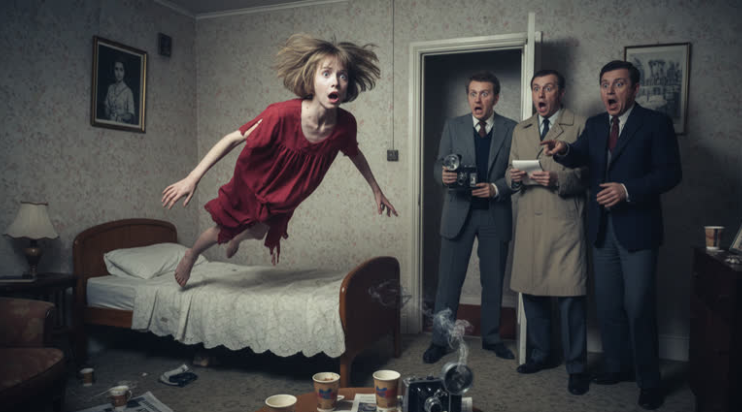
The series of photographs taken inside the Hodgson family home appear to show Janet Hodgson rising several inches above her bed. In some of the images, her body is captured mid-air with her arms and legs extended as if she has been lifted upward.
The photographs were taken in quick succession, creating a sequence that investigators later examined carefully. Supporters of the paranormal interpretation argue that the images show movement that would be difficult to fake while investigators and journalists were present in the room.
Witnesses at the time reported that the disturbances inside the house often occurred suddenly, with objects moving or being thrown without clear explanation. The photographs therefore became one of the most widely circulated visual pieces of evidence connected to the Enfield haunting.
For believers in the paranormal, the images seemed to support the idea that something unexplained was occurring inside the house.
The Skeptical Explanation
Skeptics of the Enfield Poltergeist photographs argue that the images can be explained much more simply. According to critics of the case, the pictures appear to show Janet Hodgson jumping from her bed rather than levitating above it.
Because the photographs were taken at the exact moment the camera shutter was pressed, skeptics believe the images captured Janet at the peak of a jump. When viewed in isolation, this can give the impression that she is floating in mid-air.
Some critics have also pointed out that the photographs show Janet’s body positioned in a way that resembles a typical jump. In several of the images, her legs appear bent and her arms are extended outward, which skeptics argue is consistent with someone pushing off from a mattress.
For this reason, many investigators outside the original case have concluded that the levitation photographs alone cannot be considered definitive proof of paranormal activity.
The full investigation, including the researchers who documented these events, is explored in The Enfield Poltergeist Investigation: Who Investigated the Case
Why Some Investigators Believe the Photos
Despite the skeptical explanations, some investigators involved in the original Enfield investigation believed the photographs should not be dismissed so easily. Several researchers and journalists were present inside the Hodgson home at different times during the disturbances, and many reported witnessing unusual events firsthand.
Supporters of the paranormal interpretation argue that the photographs should be viewed within the wider context of the case. Throughout the investigation, witnesses described objects moving across rooms, furniture shifting on its own, and strange knocking sounds echoing through the house.
Because the photographs were taken during a period when the disturbances were being closely monitored, some investigators believed the images captured a genuine moment connected to the strange activity reported at the home.
For believers in the paranormal, the levitation photographs remain one of the most intriguing visual pieces of evidence connected to the case.
Conclusion
The Janet Hodgson levitation photographs remain one of the most famous images associated with the Enfield haunting. While skeptics argue that the pictures simply show a child jumping from her bed, others believe the images may capture something far more unusual.
More than four decades later, the photographs continue to spark debate among investigators, skeptics, and paranormal enthusiasts alike. Whether they represent genuine paranormal activity or a moment easily explained by natural movement, the images remain an important part of the Enfield Poltergeist story.
For a deeper look at the case, read our full breakdown of what THE ENFIELD POLTERGEIST CASE (1977 – 1979) evidence exists for the Enfield Poltergeist.
Related Enfield Poltergeist Articles:
Leave a Reply